|
|
OneKSD: District News to the Board |
|
|
|
|
Superintendent's Community |
|
|
Board Member Resources and Reminders |
|
|
REGULAR BOARD MEETING
May 27, 2026
5:00 P.M. Work Session
6:00 P.M. Executive Session
6:30 P.M. Board Meeting
|
|
SPECIAL BOARD MEETING
June 9, 2026
5:00 P.M. Candidate Interviews
Immediately following - Executive Session for discussion and return to Special Meeting for selection of Board Director District 1
|
|
|
REGULAR BOARD MEETING
June 10, 2026
4:00 P.M. Work Session
6:00 P.M. Executive Session
6:30 P.M. Board Meeting
|
|
REGULAR BOARD MEETING
June 24, 2026
5:00 P.M. Work Session
6:00 P.M. Executive Session
6:30 P.M. Board Meeting
|
|
|
TIMELINE FOR HIRING DIRECTOR DISTRICT 1
Public Interviews and Selection
Tuesday, June 9, 2026
Director District 1 - Sworn in
Wednesday, June 24, 2026
|
|
|
The Outreach Program (TOP)
Wednesday, June 3, 2026
6:00 P.M.
Kent-Meridian High School
|
|
iGrad & Kent Virtual Academy
Friday, June 12, 2026
5:00 P.M.
Kent-Meridian High School
|
|
Kent Laboratory Academy
Friday, June 12, 2026
7:00 P.M.
Kent-Meridian High School
|
|
|
|
Kent-Meridian High School
Saturday, June 13, 2026
8:00 A.M. - 9:30 A.M.
ShoWare Center
|
Kentridge High School
Saturday, June 13, 2026
4:00 P.M. - 5:30 P.M.
ShoWare Center
|
|
Kentlake High School
Saturday, June 13, 2026
12:00 P.M. - 1:30 P.M.
ShoWare Center
|
Kentwood High School
Saturday, June 13, 2026
8:00 P.M. - 9:30 P.M.
ShoWare Center
|
|
|
|
Policy Updates
Policy Work Session: Wednesday, May 27, 2026, at 5:00 P.M.
The following will be discussed:
- Board Protocol Guidelines
Links to board members' individual policy work folders will be sent out on Friday, May 22, 2026. Any comments and/or suggested changes should be made by 2:00 P.M. on Wednesday, May 27, 2026, in order to be included in the work session documents.
|
Policies on the Regular Meeting: Wednesday, May 27, 2026, at 6:30 P.M.
Discussion and Approval
-
Second Reading and Approval of Policy 3245 Students and Personal Electronic Devices (PED)
- Fourth Reading and Approval of Policy 1760 Board Member Use of Electronic Communications and Social Media
Consent:
-
Retirement of Current Policy 3245 Weapons and Firearms
-
Current Policy 3245 Weapons and Firearms (last revised October 2006) is being Retired, as the information is duplicated in Policy 4210 (last revised February 2025). The most current and correct information in this policy is contained in Policy 4210 Regulation of Dangerous Weapons on School Premises.
|
|
|
|
Budget Information
Over the past several years, KSD has focused on systems coherence; aligning schools, departments, and resources to improve student learning while exercising responsible fiscal stewardship. As pandemic-related federal funds expired, the school district began a planned reduction in expenditures and realignment of resources, along with a majority of districts statewide.
Budget Context
- General fund costs average $47M/month
- Required five percent (5%) unassigned ending fund balance equals only 2.5 weeks of operations
-
Washington State is facing a deficit in the next budget cycle with total reserves predicted to dip to 1.4 percent by the end of the 2028 fiscal year
-
Implications for K-12 Education include:
-
Increased competition for limited state resources
- Elevated uncertainty about future education funding levels
- Pressure on school districts already facing enrollment declines and rising costs
Budget Reductions - KSD Approach
- The School Board established guiding principles for budget realignment planning
-
Budget reductions and realignment will have impacts across:
- Schools
-
Programs
- Departments
-
KSD commitments:
- Transparency and timely communication
- Early and clear information for staff, families, and community
-
Student-centered decision-making
- Preserving educational quality whenever possible
- Alignment with labor partner agreements
Despite past efforts to protect schools, the magnitude of over $30.0 million shortfall for the 2026-27 school year means impacts will be district wide.
Reductions at Central Office since 2022-23
Reduced Central Office staffing by 30 full-time equivalent (FTE) Source: February 4, 2026, Budget Presentation
- Materials, Supplies, and Operations Costs (MSOC) reductions
-
Travel and hiring restrictions
These reductions occurred alongside:
- Rising inflation and operational costs
- Declining enrollment
-
Underfunding by the state
Rising Inflation and Operational Costs
Washington State has not kept pace with the true cost of public education.
Rising costs in food prices, utilities, and benefits continue to exceed state allocations.
Declining Enrollment
The school district applies a well-established enrollment forecasting methodology that has demonstrated consistent accuracy over multiple years.
-
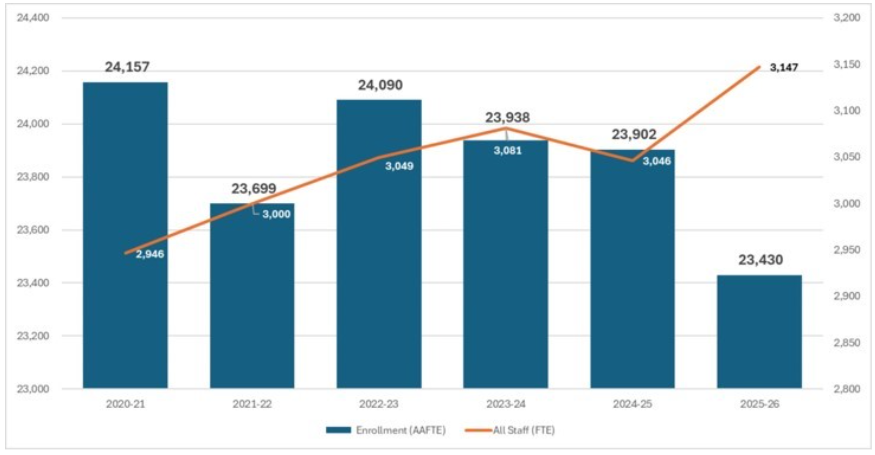
Decrease of 792 students in KSD for 2025-26
-
Kindergarten enrollment has dropped by 8.3% since 2021-22 (Source: April 22, 2026, Budget Development presentation)
-
Enrollment is projected to continue declining for the foreseeable future (Source: April 22. 2026, Budget Development presentation)
-
Statewide, public school enrollment is about 50,000 students lower than it was in the2019-20 school year
-
Statewide enrollment dropped by 9,000 students in the 2025-26 school year
-
Enrollment fell in some of the state's largest districts, including Kent, Seattle, Tacoma, and Vancouver
The 2025-26 enrollment decline was unexpected and is considered an anomaly. The district considers this as its "new" normal and has adjusted its enrollment projections moving forward.
Underfunding By the State
The share of the state operating budget allocated to K-12 education decreased from 51.6% to 43.23% between the 2017-19 and 2025-27 budgets, despite the McCleary ruling intended to fully fund education. Source: Washington Association of School Administrators
Underfunding: Staffing
KSD made a strategic choice to invest in staff, aligned with Strategic Plan Goal 4:
-
Competitive compensation
- Strong instructional support
- average teacher's salary and benefits in KSD = $145,267
To continue this momentum, the district must realign revenues and expenses and right-size for long-term sustainability.
82% of the district's expenditures are salaries and benefits. Source: February 4, 2026, Budget Presentation
KSD basic education staffing is underfunded by $65.4 million. KSD invests $267.6 million in staffing, which is $65.4 million more than the $202.2 million provided by the state to fully support staff and students and provide a high-quality education that the community expects. Source: Vela's Voice February 2026
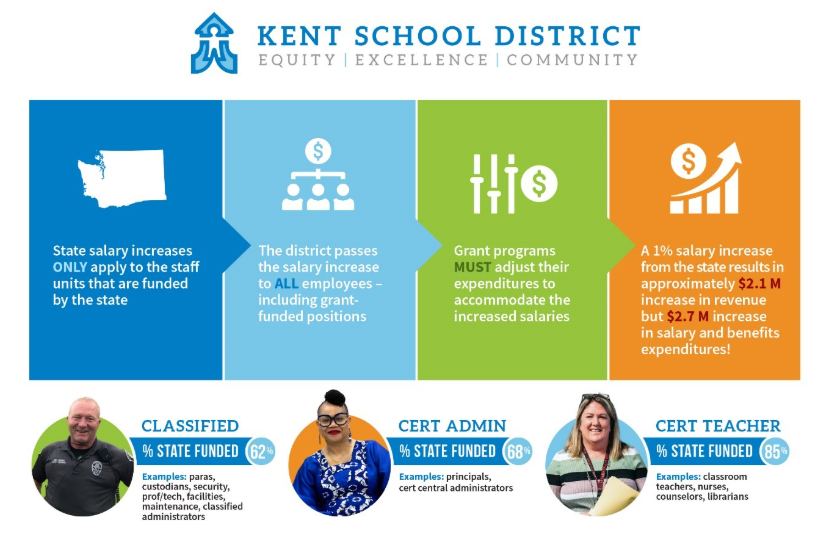
A 1% salary increase from the state results in approximately $2.1 million increase in revenue, and the increase in salary and benefits is $2.7 million.
- Classified - 62%
- Certificated Admin - 68%
- Certificated Teacher - 85%
|
For the 2026-27 school year, the estimated cost of salary and benefits increase is $16 million. Source: April 1, 2026, Budget Development Presentation
Average five-year IPD is +3.3%, while salaries and benefits increased by an average of 6.2% each year. Source: April 22, 2026, Budget Development Presentation
In the 2024-25 school year, KSD spent $121.1 million more than it received from the state, with the EP&O Levy covering approximately $80 million of that gap.
Staffing and Enrollment
KSD staffed according to projected enrollment for the 2025-26 school year and did not anticipate a decline., which is considered an anomaly given that the same staffing formula has historically produced fairly accurate results over several years.
|
|
|
|
Unfunded State Mandates
Districts are managing over 100 state-required mandates that are not fully funded. Since 2017, there have been 101 unfunded mandates.
School construction requirements The state requires safe school facilities but doesn’t provide funding for upkeep or new facilities. Local communities are left to foot the bill by passing a bond measure that requires a 60% supermajority.
Staffing mandates, SEBB benefits, and leave costs Substitute employee salaries, SEBB benefits costs, Paid Family & Medical Leave (PFMLA) premiums, and Family & Medical Leave Act (FMLA) costs are not fully funded by the state.
Public records request compliance costs State law (RCW 42.56) requires public agencies, including school districts, to make records available upon request. Staff time to locate, redact, and produce records can be costly, especially with enormous records requests that take months to fulfill.
Green Schools requirements. Districts are mandated to comply with the Washington Clean Buildings Act, yet no dedicated funding stream exists to support the substantial capital and operational upgrades required. Compliance without funding diverts resources away from educational services and increases long-term financial strain.
View all 101 unfunded mandates
Source: Washington Association of School Administrators , Puget Sound Regional Districts Legislative Positions
2025-26 Budget Gap (Resolved)
Source: December 3, 2025, Budget Update
The district implemented $7.1 million in budget reductions and used some of its unassigned fund balance to resolve the budget gap.
In October 2025, KSD confirmed a loss of 792 students from the original enrollment projection, which resulted in a reduction of its revenues by $14.4 million.
This amount increased the projected budget deficit to $29.3 million ($14.9 million during the budget adoption, plus $14.4 million loss in revenue) and the unassigned fund balance would have fallen below the minimum required level.
2026-27 Budget Gap Realignment - In Progress
-
Projected shortfall: $30.5-$35 million
-
Potential areas of reduction:
- Building supports: $4.0-$4.5M
- Categorical programs: $3.0-$3.5M
-
Central office: $2.5-$3.0M
- Class size: $11.0-$12.0M
- Materials, Supplies, and Operating Costs: $1.0-$2.0M
- Operations: $1.5-$2.0M
-
Program adjustments: $7.0-$8.0M
Staffing forecast projects there will be positions for all current teachers and paraeducators for the 2026-27 school year.
Right-sizing staffing to enrollment, in alignment with labor partner agreements, will be addressed through attrition as much as possible.
Class sizes and rations for 2026-27 will be in accordance with the provisions of Article 7.2 - Workload of the KEA/KSD collective bargaining agreement.
- Grades K-3 Class Size: 25:1
- Grades 4-5 Class Size: 28:1
- Grades 6-8 Ratio: 26:1
- Grades 9-12 Ration: 29:1
Source: April 1, 2026, Budget Update
|
Kent School District Strong Financial Stewardship
-
S&P credit rating upgrade (Sept. 2025):
- S&P cited:
- Improved financial management
- Positive operating results in recent years
- Rebuilt fund balance after 2018 distress
- Strong oversight, multi-year forecasting, and cost containment
Kent School District Energy Management Savings
Kent School District has implemented a series of energy saving strategies over the past three years. These actions have helped the district avoid more than $271,000 in energy costs.
Regional Comparison of Administrative Costs
For the 2025–26 school year, Kent School District continues to demonstrate fiscal responsibility by keeping central administrative costs below regional averages.
Kent School District’s central administration represents 5.98% of the total General Fund budget, which is lower than the regional average of 6.60% and well below several neighboring districts.
2025-26 Annual Budgets (source: OSPI, Annual Budgets (F-195) for each district *Note: Central Administration includes activity codes 11, 12, 13, 14, 15, 21, 41, 51, 61
|
|
|
|
|
Total General Fund Budget (millions) |
|
Central Administration Budget (millions) |
|
Central Administration
% of Total
|
|
|
Non-Represented Management is currently only 1.9% of the FTE staffing budget. Source: April 1, 2026, Budget Update
Regional Context - School District Budget Gaps
KSD is far from alone. Districts throughout the Puget Sound region face severe structural deficits due to enrollment declines, inflation, and insufficient state funding. Below is a district‑by‑district breakdown of verified shortfalls over the past few years.
|
|
|
School Districts in Binding Conditions
-
When districts cannot produce a balanced budget, OSPI may impose Binding Conditions
-
Current districts under binding conditions include:
-
Bellevue
- Marysville
- Mabton
- Mount Baker
- Prescott
- Shelton
-
Yelm
- These conditions underscore the urgent need for comprehensive statewide funding reform
Moving Forward as OneKSD
We continue to work hard to address the projected $30.5 million deficit. As OneKSD, we remain committed to student learning, strong financial practices, and right‑sizing for long‑term stability.
The decisions we have made over the last few years, and the ones we must make now and in the future, are helping build a sustainable path forward for our schools and students
Despite the complexity of the work ahead, along with the increasingly challenging statewide context, KSD remains committed to its mission: successfully preparing all students for their futures.
A continuous structural deficit in the current (2025-2026) and projected years, which requires the school district to implement budget realignment for the next three years to maintain a five percent (5%) minimum unassigned ending fund balance.
The following actions must be taken to maintain a minimum of five percent (5%) unassigned ending fund balance:
- 2026-27 A permanent budget cut of at least $30.5 million
- 2027-28 An additional permanent budget cut of $9.5 million
-
2028-29 An additional permanent budget cut of $9.5 million
Source: April 1, 2026, Budget Update
EP&O Levy will expire on December 31, 2027. Community support is critical to maintain or increase this funding source of approximately $80 million annually.
|
|
|
Teaching & Learning Community
|
|
|
Program Overview
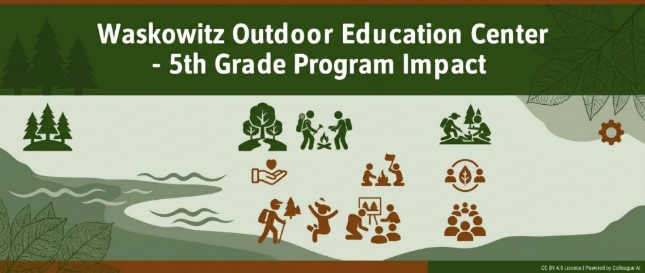
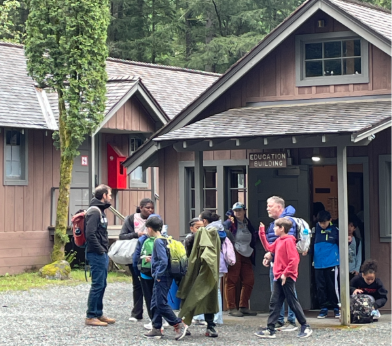
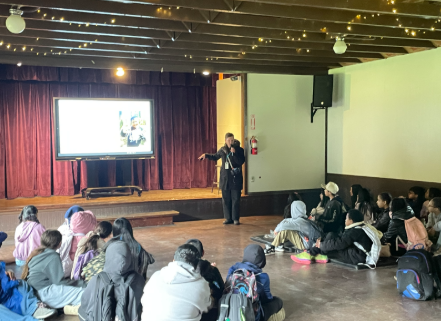
During the 2025-26 school year, 5th grade students from all 30 elementary schools participated in an extended day outdoor education program at Waskowitz Outdoor Education Center. Students explored forest and riverside ecosystems through structured lessons, hands-on activities, and collaborative group work. The program provided immersive learning experiences that connected students with nature while building scientific inquiry skills and fostering community.
Educational Experience
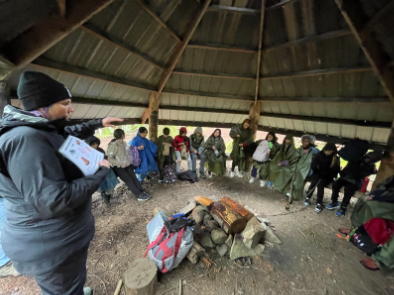
The program day began with introductions and reflections on personal relationships with the land, establishing a foundation for meaningful engagement with the natural environment. Students participated in observation-based activities designed to spark curiosity and scientific inquiry, investigating the central question "What lives here?" Through field guide exploration, evidence analysis, and hands-on investigation of decomposing logs, students discovered the rich biodiversity of local ecosystems.
Throughout the experience, students built understanding of ecosystem dynamics by observing patterns, making connections, and creating models that illustrated interactions between living and non-living elements. The day concluded with structured reflection activities that encouraged students to share insights and build community connections. Evening programming enhanced the experience through social activities including skits, dancing, and campfire gatherings that strengthened peer relationships and created lasting memories.
Program Impact and Attendance Growth
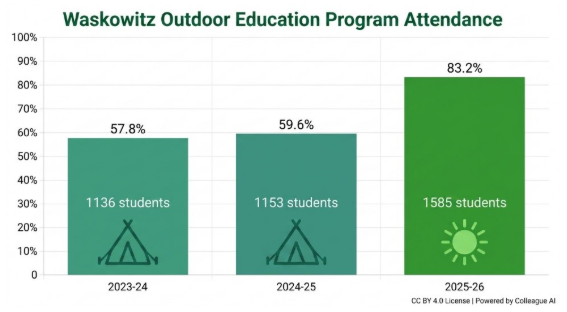
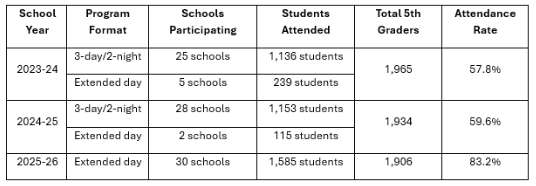
The transition to an extended day format resulted in significantly higher participation rates compared to the previous overnight program models.
|
Key Outcomes
Increased Student Attendance: The extended day format resulted in 1,585 students participating, representing an 83.2% attendance rate. This marks an increase of approximately 24 percentage points and 320 additional students compared to the previous year's overnight programs.
Accessibility Success: The extended day model removed barriers associated with overnight stays, including cost concerns, family concerns and schedules, and student comfort levels, resulting in a higher participation rate.
|
|
|
Special Education Annual Determination
This notification provides an update regarding the annual IDEA determination process conducted by the Washington Office of Superintendent of Public Instruction (OSPI), placing KSD at a Determination Level 4. As part of the Individuals with Disabilities Education Act (IDEA), states are required to annually determine the level of compliance and performance of school districts in meeting special education requirements and outcomes.
During the 2025-26 school year, the district has demonstrated measurable progress toward identified areas of improvement through focused action planning, strengthened monitoring systems, and targeted supports for students receiving special education services in partnership with OSPI. Based on this progress, the district has received confirmation that required improvement efforts are moving in positive direction, and associated funds have been released.
District leadership will continue to monitor progress, implement improvement strategies, and partner with schools and families to ensure high-quality services and equitable outcomes for all students. This commitment has also been shared at the board work sessions related to the comprehensive special education review conducted this school year.
|
|
|
Instructional Integration |
|
|
Multi-Tiered System of Supports (MTSS)
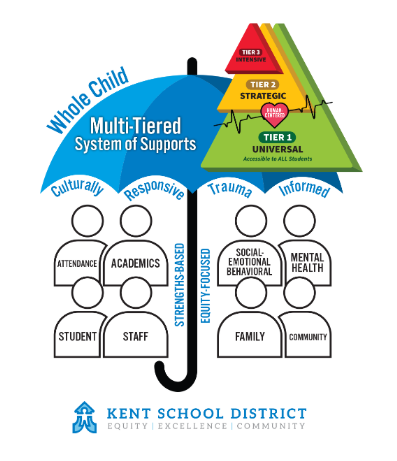
An MTSS Implementation Team was created in Semester two of the 2024-25 school year. The team, and its sub-committees, is comprised of KSD staff across all grade bands and multiple positions, including district and building administrators, school psychologists, counselors, behavior interventionists, paraeducators, social workers, educational assistants, deans, and teachers. This school year, the team engaged in a comprehensive professional learning journey beginning with studying the foundational structure and essential components of school-based MTSS teams and then applying these concepts to their individual school buildings to ensure contextually appropriate implementation. Following this foundational work, the team participated in a book study of Implement with Impact, which provided them with a strategic framework for leading both school-level and district-level initiatives. This framework equipped team members with tools to guide implementation efforts systematically and effectively across multiple sites.
Sub-committees coordinated to further district-wide cohesion for the following:
- Tier 1 and Tier 2 resource mapping, including initial steps to determining diagnostic and progress monitoring tool needs
-
Determining a viable means for building staff to track interventions and student data for fidelity and increased student learning outcomes
- Creating a common referral process for schools to implement in 2026-27
- Foundational documents and guidance for new behavior and discipline systems
-
Tier 3 behavior intervention planning
For the remainder of this academic year, the MTSS Implementation Team will focus on learning and applying specific fidelity assessment tools. These tools will enable the team to evaluate the current implementation levels across buildings, identify gaps in practice, and determine targeted action items to ensure the long-term sustainability of KSD's MTSS structures and practices district wide.
|
|
|
Office of School & Leadership Success |
|
|
Kent Rotary Recognition - May 2026
On May 12, 2026, the Kent Sunrise Rotary Club concluded its 2025-26 recognition program by honoring Canyon Ridge Middle School students and staff during the final monthly breakfast and ceremony of the school year. Two students were recognized in person for academic excellence, while two additional students were honored for service and citizenship. Once classified staff member and one certificated staff member also recognized in person.
The certificated teacher honored was praised as "a strong instructional leader who has helped shape both her department and broader school culture," with students describing her as "kind, approachable, and fair, with strong expectations." The classified staff member, Head Custodian, was described as someone who "embodies a 'Service Above Self' spirit" and "always responds to requests with a pleasant tone, even when the task is unpleasant," while also leading a student cafeteria cleanup crew.
Students honored for service and citizenship included "a leader among his peers who played an important role in helping launch Canyon Ridge Unified sports teams and clubs," and a student who "serves as a representative on the Kent School District Student Advisory Committee." Students recognized for academic achievement include one who "elevates group work through collaboration, careful listening, and clear communication," and another commended for "fostering inclusive discussions, sharing insights, and ensuring every voice is heard," who also won the OneKSD Art Contest for her piece "Equity Creates Happy Students."
This recognition concludes another successful year of partnership between Kent School District and Kent Sunrise Rotary Club.
|
|
|
Standards Based Learning Secondary
The Standards Based Learning (SBL) guide coalition concluded its work for the year with a final meeting focused on planning professional development for pilot teachers. This team of secondary teachers and administrators has met bi-monthly since spring 2025 to plan for SBL implementation at the secondary level.
The coalition provided input on training scheduled for June 22-23, 2026, designed to support Phase One pilot teachers - sixth grade English Language Arts (ELA) teachers who will pilot one unit during the first semester. Day one will offer a condensed introduction to SBL, previously provided to all schools in fall 2025. Day two will prepare pilot teachers for implementation, including identifying and unpacking priority standards, aligning instruction to standards, supporting student reflection, and developing assessments.
The guiding coalition reviewed the proposed learning targets for the training and emphasized the importance of establishing shared definitions and understandings of key vocabulary such as formative and summative assessment, as well as agreements on components of learning targets and success criteria. Members discussed the critical role of feedback to students in relation to learning targets and stressed that rubrics must be directly related to standards and designed for fidelity of use by both students and teachers. The coalition's careful consideration of adult learning principles contributed to designing professional development that will be both impactful and actionable for pilot teachers as they begin implementation in the fall. Executive Directors Darice Johnson and Jim Schiechl extend appreciation to the guiding coalition members for their leadership, expertise, and dedication throughout this important work.
|
|
|
Technology & Partnerships Community |
|
|
Technology Operations & Support Services |
|
|
Technology Costs and Stewardship of Public Funds
At the May 13, 2026, Board Meeting, questions were asked regarding opportunities to reduce or streamline software and subscription costs, and whether the district may be paying for systems that are no longer needed or fully utilized.
The Technology teams take a disciplined approach to managing the system, software, and licensing they oversee. This includes reviewing software and licensing agreements, renegotiating vendor contracts, eliminating redundant systems, and ensuring each system provides clear operational value. While all contracts and expenditures are continuously reviewed, below are examples that highlight several of the larger and more impactful efforts over the last few years.
Technology Levy (Voter-Approved Investments)
- This year, device refresh purchases were executed below standard cooperative contract rates, allowing the district to procure higher-quality devices and additional value within the same budget, representing more than $15 million in improved purchasing value compared to current pricing levels.
-
These purchases were completed through cooperative contracts for compliance while leveraging vendor competition and timing strategies to drive pricing below baseline rates.
- During the pandemic, the district secured the largest allocation of federal technology funding in the state, totaling over $9 million, nearly double the next closest district.
General Fund (Operational Cost Reductions)
-
In March 2025, Microsoft Defender for Endpoint licensing was negotiated at approximately 50% below standard pricing, resulting in over $155,000 in annual cost savings.
- E-Rate consulting services were reduced by over $100,000 annually through renegotiation and competitive sourcing. Annual negotiations have seen a decline in costs over the last three year.
-
Inventory management systems were structured to include additional functionality at minimal or no additional costs, avoiding approximately $60,000 annually in unused support costs.
- Continued software review practices have allowed for the team to discontinue software where functionality already existed within current tools. An example of this work is the discontinuation of Poppulo. Savings from this work over the recent years totals approximately $37,000 annually.
-
Renegotiation of web filtering services (Lightspeed) reduced annual costs by approximately $60,000 beginning in September 2025 and will continue into the coming year.
- Reduced transcript and records management costs (Parchment) through contract negotiation lowered annual licensing expenses starting September 2025.
-
APC infrastructure support contracts are continually being refined to meet the district's support needs. While there has been a year-over-year decrease in these costs, this year saw a reduction in annual costs by approximately $30,000.
Contract Management and Cost Containment
-
A multi-year agreement for the districts learning management system was negotiated and resulted in the district avoiding a significant cost increase compared to the original vendor proposal. This effort resulted in over $215,000 in avoided costs across the contract term.
Every scenario is unique, and some systems utilize standardized pricing models that apply across districts. In these cases, the focus shifts to efficient use and alignment rather than cost reduction.
Summary
To support and maximize district resources, the Technology teams plan for expected market costs while actively pursuing savings and efficiencies in every major contract and purchase they oversee by negotiating prices, bundling functionality, and working to limit cost increases wherever possible. This includes leveraging external funding to offset local costs and maximizing the value delivered from both levy and general fund investments.
|
|
|
Human Resources Community |
|
|
Equity & Employment Support |
|
|
|
School Involvement
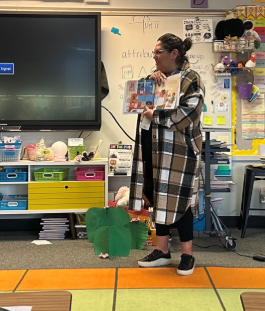
Irene Aguilar, Director of Equity & Employment Support, spent time in Mrs. Gachugu's class to read from one of her favorite books, Cultivando A Un Artista. The story follows a young boy named Juanito, who accompanies his father as he designs gardens for work. As they travel together, Juanito sketches plants, flowers, and scenes of his father working on the land, discovering his own creativity along the way.
Mrs. Aguilar read the book in Spanish and narrated the story in English, allowing all students to engage with the story in both languages. The students were excited to learn they would get to keep the book after Mrs. Aguilar read it to them. One student shared that he already knows how to read in Spanish, though some of the words were challenging. The student said he plans to practice the difficult words and hopes to read the book aloud to the class himself in the future.
Community Involvement
At the beginning of May, Mrs. Aguilar had the honor of serving as a panel member for the "Speak Your Truth Poetry Slam & Mental Wellness Summit." The event was sponsored by Regional Executive Leaders of Color (RELOC), Learning and Teaching Puget Sound Educational Service District (PSESD) Family Support, and the Youth Wisdom Council.
During the event, students had the opportunity to engage with panel members, ask questions, and connect through meaningful conversations about the challenges and experiences they are navigating.
|
|
|
West Central District 4A Champions - Kentwood
Kentwood girls golf is headed back to the State Championships after capturing the West Central District 4A title for the second consecutive year.
The Conks delivered an outstanding team performance to secure the back-to-back district championship and continue a strong season.
Leading the way, Avery earned individual medalist honors, finishing in first place with an impressive two-day total of 1-under par. The team's success reflects the dedication and leadership of coaches Dan and Ann, whose continued support has helped elevate the program.
Kentwood also saw a strong showing from Alia, who competed in her first district tournament and narrowly missed qualifying for State, an encouraging sign of future success for the program. The Conks now look ahead to State competition with momentum and confidence as they represent Kentwood on the next stage.
|
|
|
KSD Athletes Shine at North Puget Sound League Track & Field Championships
KSD student-athletes delivered an impressive showing at the North Puget Sound League (NPSL) Track & Field Championships, with several athletes earning league champion honors across multiple events. Kentwood (KW) also captured the NPSL Inclusive Division team championship, highlighting the district's continued commitment to inclusive excellence in athletics.
Leading the way, Romeo Cabansag II (KW) claimed three league titles in the 100M, 200M, and Long Jump, while Chloe Williams (Kentridge KR) captured championships in the 200M, 400M, and 300-meter hurdles.
Kent-Meridian's (KM) Sam Doma and Candice Le each secured league titles in the Pole Vault, while Jasmine Johnson (Kentlake KL) earned a championship in the 100-meter hurdles. Mara Winmill (KR) added a league title in the Discus.
In Inclusive Division competition, Alexxavier Borsheim (KW) delivered a standout performance earning league titles in the 200M Ambulatory, 400M Ambulatory, and Shot Put Ambulatory.
These athletes will be joined by additional Kent qualifiers at the upcoming West Central District (WCD) meet, where they will compete for advancement and the opportunity to secure State Championship berths. The performances highlight the depth of talent across KSD schools and reflect the dedication and commitment of student-athletes and coaches throughout the season.
|
|
|
Kentlake Baseball Secures State Berth with Runner-Up Finish at West Central District Tournament
Kentlake High School baseball earned a second-place finish at the WCD tournament, securing a spot in the Washington Interscholastic Activities Association (WIAA) 3A State Baseball Championships as the No. 6 seed.
The Falcons will open State tournament play over Memorial Day weekend at Everett Memorial Stadium, where the team will face Southridge on May 23, 2026, in a loser-out, winner-advances matchup. KL enters State play with momentum following a strong postseason performance and will look to continue its success on the statewide stage. Fans can follow the tournament bracket and game updates here: WIAA State 3A Baseball Bracket.
|
|
|
Kentridge Girls Tennis Advances to State
Kentridge High School will be represented at the WIAA 4A Girls Tennis Championships, as Grace Cho and Minh Nguyen have qualified to compete on the state stage. Their advancement reflects strong postseason accomplishment, and the Chargers will look to carry that momentum into competition against top athletes from across Washington.
|
|
|
|